WHAT IS WOOD INDUSTRY ECONOMICS ?
Economic of wood industry is the application of economic principles to various of wood resources through the processing marketing. For example, furniture, pulp and paper.


topic: how sawn timber production contribute to wood industry in malaysia
OBJECTIVE: TO DETERMINE THE GROWTH OF SAWN TIMBER PRODUCTION
WHAT IS SAWN TIMBER?
Sawn timber is timber that is cut from logs into different shapes and sizes. Sawn timber is generally cut into varying rectangular widths and lengths, but may also be wedge shaped. Common sawn timber products include solid timber beams and more rectangular timber sections.
Sawntimber Types
· Meranti / Seraya / Serai / Lauan / Luan / Lawaan / Shorea
· Menggris
· Kapur / Keladan / Dryobalanops
· Keruing / Gurjan / Dipterocarpus
· Selangan Batu / Balau
· MLH / Mixed Light Hardwoods
Sawntimber Size
· Thickness: 22mm/ 0.75’’ and Up
· Finger Joint Stick: 15-50mm X 30-70mm
· Laminated Board: 18-50mm X 100-500mm
Sawntimber Width
· 40mm/1.625’’ and Up
Sawntimber Length
· 1.0m/3’ and Up
Sawntimber Cut
· Rough Sawn
· Flat Sawn
· Quarter Sawn
Sawntimber Mouldings
· Surfaced Four Sides (S4S)
· Surfaced Two Sides (S2S)
· Profile Decking
· Finger Joint Stick
· Tongue & Groove
· Edge-Joint Laminated Board
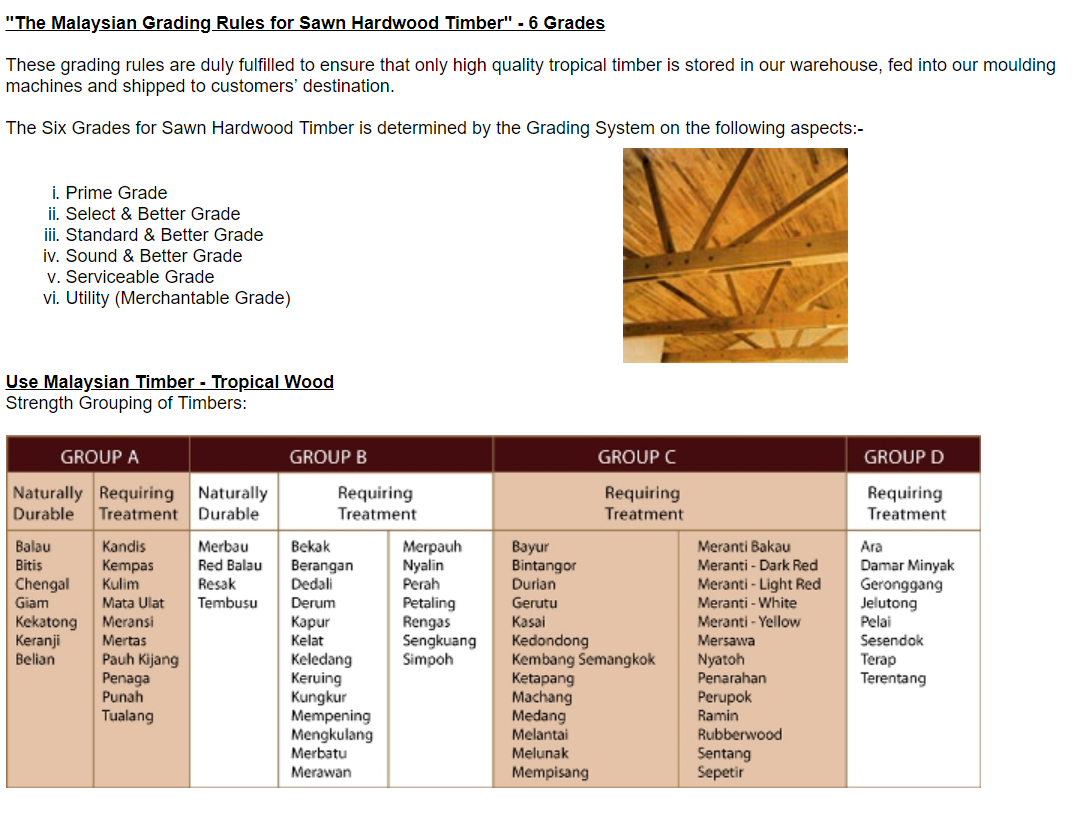
Sawntimber Grading
· Malaysian Grading Rules (MGR)
· Japanese Grading Rules
Sawntimber Applications
· Claddings
· Furniture
· Linings
· Mouldings
· Wall frames
· Roof framing (including trusses)
· Floor joists and bearers
· Lintels & beams
· Foundation piles
· Outdoor (eg decking, fencing and landscaping)
· Pallets
· Packaging
· Crates
SOURCES OF SAWN TIMBER IN MALAYSIA
List of Certified Timber Suppliers and Treaters, abbreviated as CST is a special listing of selected suppliers and treaters of timber in particular sawntimber, who have succesfully complied with the requirements of a Quality Assurance Scheme (QAS) implemented by MTIB.
The QAS was established by MTIB in collaboration with FRIM following the aftermath of the JKR suspension on use of timber for roof trusses. One of the main concerns of JKR (and PAM as well) was with regard to the quality of timber that are supplied for construction projects in the domestic market.
An idea was mooted to establish a QAS and register suppliers and treaters who could comply with the requirement of the QAS. JKR, PAM and CIDB are committed to make a purchasing decision limiting to source timber that supplied by suppliers listed in the CST.
Demand and consumer for sawn timber
Demand for high quality and certified imported sawn timber products will increase significantly in Malaysia and the region, according to a timber expert.In Malaysia, sawn timber accounts for 70% of the company's total sales. He said about 51% of the sawn timber was sold to furniture makers and the remainder to flooring and door manufacturers as well as retailers.
Data and statistic
Domestic demand
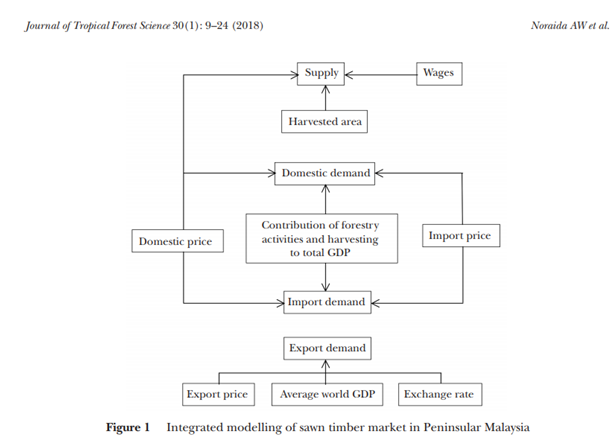
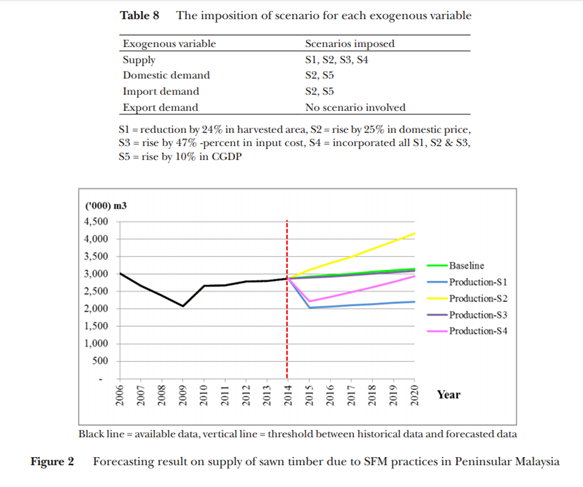
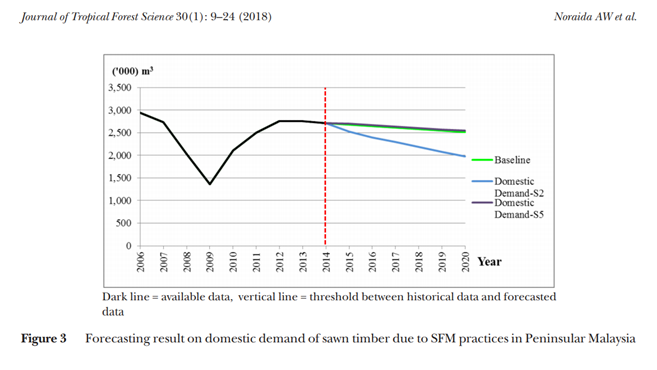
For domestic demand of sawn timber, Scenarios 2 and 5 increased by 25% in domestic price and 10% in CGDP, imposed on the forecasted domestic demand line. Based on Figure 3, the baseline (green line), Scenario 2 (blue line) and Scenario 5 showed a decreasing trend. However, once Scenario 2 was imposed in the gap between baseline and Scenario 2, the forecast lines increased. These were due to the domestic price of sawn timber having a relatively high coefficient value (0.270) compared with other variables, LIB (0.084).Scenario 5 (purple line) was above the baseline. This impact analysis, expressed in numerics, is shown in Table 10. The domestic demand of sawn timber showed negative effects with scenarios under SFM practices. Imposing the domestic price (increased by 25%) gave way to decreased demand for domestic market. The result suggested that consumers imported sawn timber because the price from domestics was higher than the international market. Unstable domestic price forced consumers to choose imports.
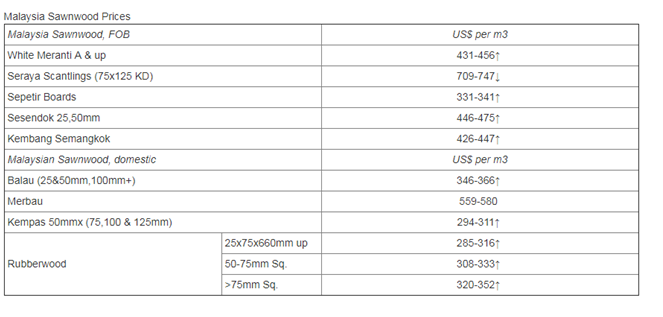
Price of sawn timber
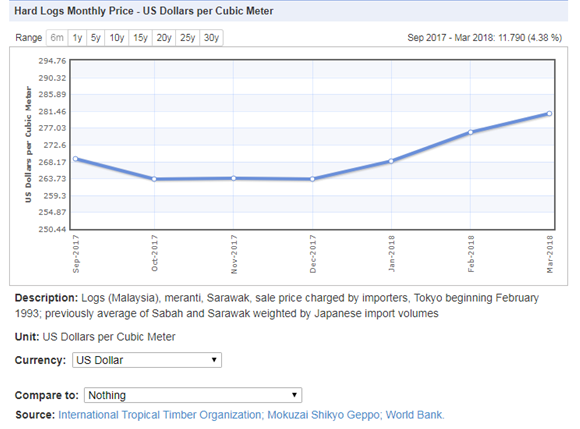
Price of Malaysian sawnwood continued to rise in part due to surging global commodity prices, higher fuel costs and bad weather.
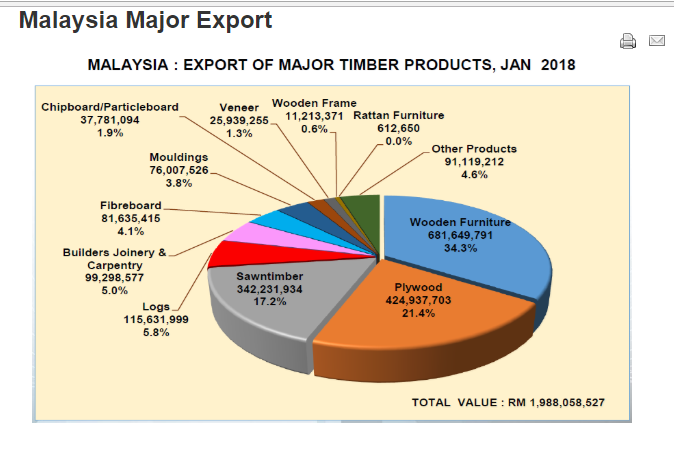
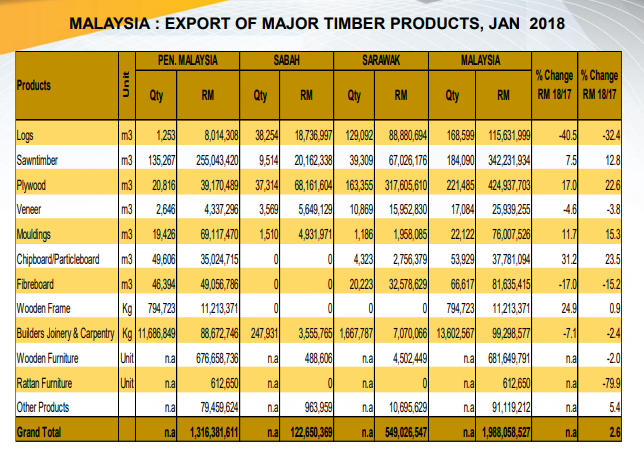
THE EXPORT AND IMPORT OF SAWN TIMBER IN MALAYSIA
(DATA FROM MALAYSIAN TIMBER INDUSTRI BOARD 2018)
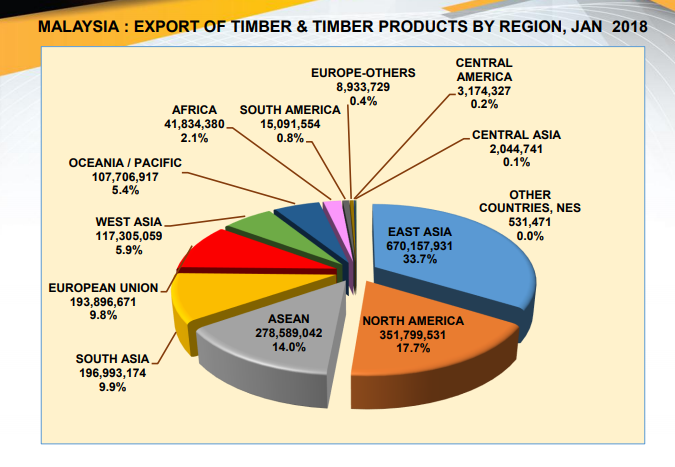
EXPORT TO MALAYSIA
EXPORTED BY REGION
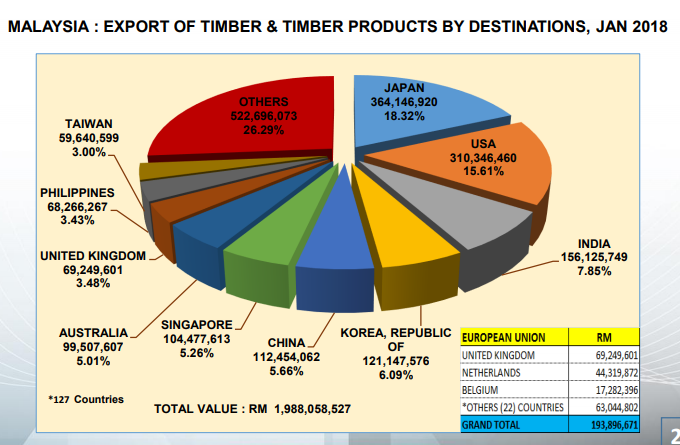
EXPORT PRODUCTS BY DESTINATIONS
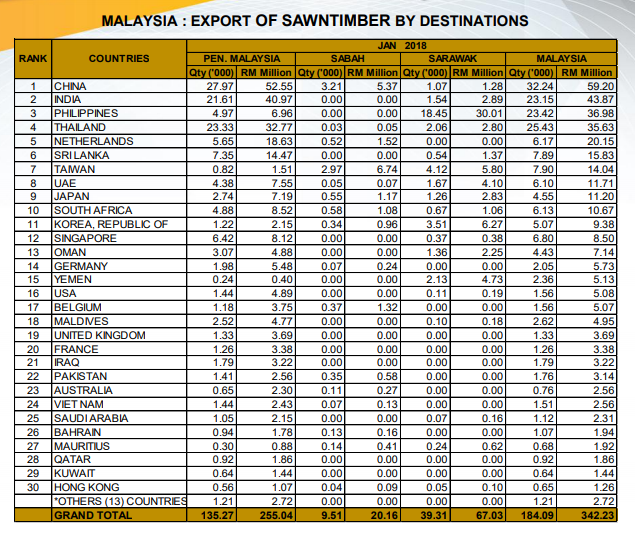
EXPORT OF SAWN TIMBER
IMPORT FROM MALAYSIA
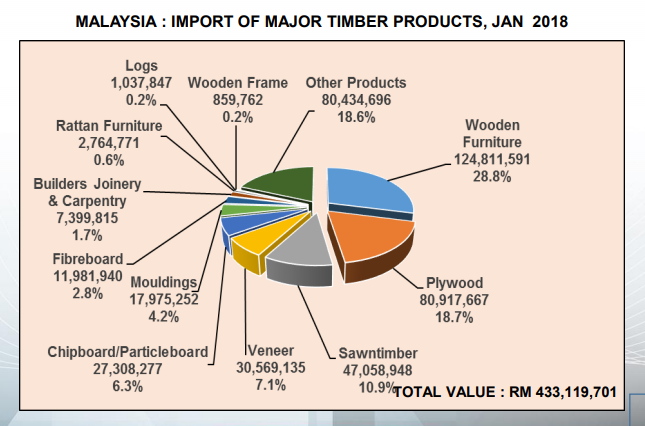
IMPORT OF MAJOR TIMBER PRODUCT
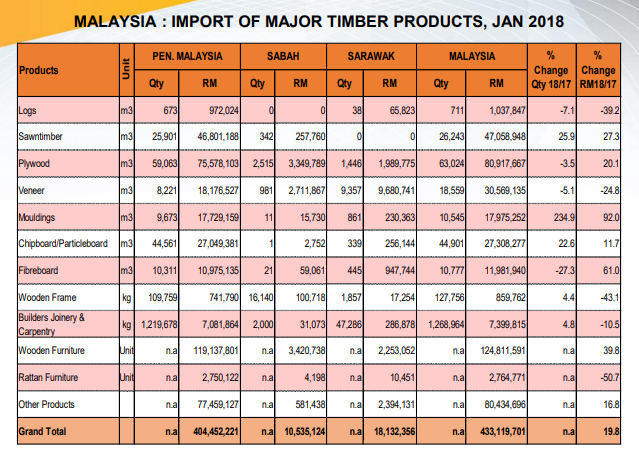
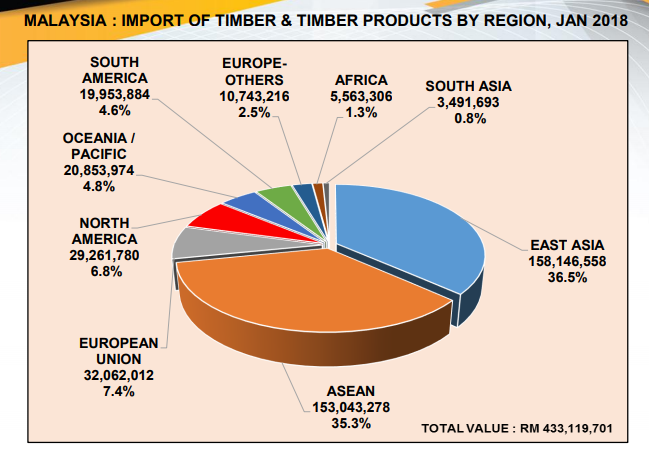
IMPORT BY REGION
Issues
Ever since the global decrease in tropical forests became a matter of concern in the 1980s, timber-importing countries have been making efforts to draw up a framework for timber import and procurement designed to prevent illegal logging and to promote appropriate forest management.
To address global illegal logging issues, the Japanese government decided in 2006 that timber products and building materials whose legality has been verified should be preferentially procured, and as a guideline for suppliers of wood and wood products, the Forestry Agency published the "Guideline for Verification on Legality and Sustainability of Wood and Wood Products" (hereinafter the "Guideline"): ten years will have passed in February 2016 since this Guideline was published.
For certification, there is also forest certification. Forest certification has two purposes, firstly to certify standards of forest management(forest management certification), and secondly to certify that timber products are made from wood sourced from the certified forests (chain-of-custody (CoC) certification). Forest certification in Malaysia started with the implementation of the Malaysian Timber Certification Scheme (MTCS) in 2001. This paper highlights the current status of the Malaysian forest industry's participation in forest certification and trade of certified timber products. To date, about 5.39 million ha of forests in Malaysia are certified. The largest area is Pahang FMU (1,524,827 ha), followed by Perak FMU (991,436 ha) and Sabah (557,452 ha). As of 2015, slightly more than 500 firms are CoC certificate holders, thus participation in CoC certification is considered low as this number is much lower than the number of forest product manufacturers and traders in the country. The European market has been the major export destination for MTCS-certified timber products, and more recently other markets including the Middle East, USA, Australia, New Zealand, India and South Africa have accepted these timber products. Even though export of these timber products is increasing, their share of Malaysia's timber products export is not significant. The greatest challenge is to increase market acceptance of MTCC's certification scheme and thus expanding the market for MTCS-certified timber products.
The certification is from Malaysian Timber Certification Council (MTCC). In line with the forestry management and timber policies of Malaysian Government, and a registered member to Malaysian Timber Council (MTC), it is PMH’s commitment and obligation to fulfill the Council’s and Malaysian government timber rules and regulations. All the exported sawn timbers and wood products has to fulfill the standard and certified by the MTCC (Malaysian Timber Certification Council), and also certified for Chain of Custody (CoC).

Conclusion
To conclude, the timber industry in Malaysia has come a long way from its beginnings in the late 19th century, and its subsequent progression and growth in becoming not only one of the major revenue contributors to the country’s economy, but also one of the major suppliers of tropical timber in the global timber market. However, in the past few years, the sawn timber industry in Malaysia has been beset by many issues such illegal logging, pollution, climate change, etc. Therefore, it is imperative that the Malaysian government, the forestry departments and all organizations and bodies involved work together in order to sustainably manage the forest and its resources for long lasting benefits.
Glossary
Sawn timber - Timber that is cut from logs into different shapes and sizes
Softwood – Timber that comes from gymnosperm trees which usually have needles and cones.
Hardwood – Timber that comes from angiosperm trees that are not monocots; trees are usually broad-leaved.
Illegal logging – The harvesting, transporting, processing, buying or selling of timber that violate national or sub-national laws.
Forest Certification - a market-based, non-regulatory forest conservation tool designed to recognize and verify that on-ground management of forests meets defined standards that promote environmentally-responsible forestry and sustainability of forest resources.
ITTO – International Tropical Timber Organization; an intergovernmental organization that promotes conservation of tropical forest resources and their sustainable management, use and trade.
MTIB – Malaysian Timber Industry Board
SFM – Sustainable Forest Management; environmentally appropriate, socially beneficial, and economically viable management of forests for present and future generations
MTCC – Malaysian Timber Certification Council; an independent organisation that develops and operates the Malaysian Timber Certification Scheme (MTCS) which provides for independent assessment of forest management practices, to ensure the sustainable management of Malaysia’s natural forest and forest plantations, as well as to meet the demand for certified timber products.
